
3 November 2006 - Friday
Farewell
I have decided that it is time for me to discontinue The Elfin Ethicist. In fact, I knew several months ago that I would end it around this time.
I began blogging early in my undergraduate career, while I was still a teenager. (That was probably a mistake.) Over the months, The Elfin Ethicist has revealed my moments of creativity and boredom; fear and optimism; irritation and joy; pretentiousness and silliness; and immaturity and, I hope, some growth in understanding. My audience has changed as I have changed, and the site seems to serve a different purpose now from what it once did, if any at all.
Interestingly enough, my subtitle is more appropriate than ever.
Because The Elfin Ethicist bears the scars of my undergraduate years, because it no longer has a clearly defined target audience, because of my desire for a clean break as I begin my graduate studies, and because I anticipate having little time or confidence to post this year, I am stopping now.
Of course, I do not anticipate leaving the blogosphere entirely. I will still be reading weblogs and commenting occasionally. And someday, I may start writing for the web again.
Goodbye, everyone. It's been interesting.
| Posted by Wilson at 17:31 Central | Link | TrackBack (0)
| Report submitted to the Communications Desk , Life Desk
2 November 2006 - Thursday
History Carnival XLII
The forty-second History Carnival has been posted at Holocaust Controversies. This edition has Pilgrims and castles and lawyers and suffrage and all sorts of other good things.
| Posted by Wilson at 8:14 Central | Link | TrackBack (0)
| Report submitted to the Communications Desk
21 October 2006 - Saturday
Reading list
Terry Eagleton excoriates Richard Dawkins for "philistinism and provincialism."
Richard N. Haass believes we are entering a new era of Middle Eastern history -- an age in which Western powers are losing influence as local radicals gain power.
Peter Berkowitz disparages George Lakoff's attempt to distinguish between liberal and conservative views of freedom in America.
National Review's Jonah Goldberg admits that the Iraq war was "a worthy mistake."
Update: An early modern edition of Carnivalesque is up at Recent Finds Weblog.
| Posted by Wilson at 17:14 Central | Link | TrackBack (0)
| Report submitted to the Communications Desk
15 October 2006 - Sunday
History Carnival XLI
The forty-first History Carnival is up at ClioWeb. Among the entries:
Andy F. Brian tells the sad, sad tale of Indiana Jones' denial of tenure. >>Mark Grimsley has challenged his readers to decide which fields should be represented on a 15-member history faculty. >>
Tim Abbott notes that Willie and Joe, Bill Mauldin's cartoon GIs, had a rocky career after the Second World War ended. >>
Blogger "Gracchi" critiques Bailyn critiquing Berlin critiquing utopians. >>
| Posted by Wilson at 18:22 Central | Link | TrackBack (0)
| Report submitted to the Communications Desk
4 October 2006 - Wednesday
Reading list
In the current issue of The American Conservative, John Zmirak tries to combat the polarization of American politics by asking both parties to play an uncomfortable game of Let's Pretend. (HT: Caelum et Terra)
Crooked Timber's famous academic blogroll is now a wiki with its own URL.
Teachers happen because of the example of other teachers. Mark Grimsley got a chance to say thank you to one of his.
A Non-Philosopher's Guide to Philosophical Terms. (HT: Siris)
| Posted by Wilson at 9:51 Central | Link | TrackBack (0)
| Report submitted to the Communications Desk
22 September 2006 - Friday
Reading list, legal edition
Chicago law professor Geoffrey Stone notes that the Bush administration is undermining a legal right that, according to Justice Scalia, "dates back to Roman times."
Speaking of, Jacob T. Levy has posted a roundup of Balkinization entries on "executive power, torture, and the Bush administration's extravagant constitutional claims."
Radley Balko has a good article at Reason on the case of Cory Maye. He is still on was sent to death row for self-defense, in what appears to qualify as a judicial lynching.
In December 2005, as Evans was preparing Maye's appeal, he received a phone call from Prentiss Mayor Charlie Dumas, who is close to Officer Ron Jones' family. Dumas told Evans that several of the town's aldermen had expressed concern about his decision to handle Maye's appeal. Although representing an indigent defendant on appeal was Evans' job as the town's public defender, Dumas told Evans he could lose that job if he continued to act as Maye's attorney. Evans ignored the threat.Update: An appeals judge has ruled that Maye will receive at least a new sentencing trial, so for the moment Maye is no longer sentenced to death. Also, we now know who the confidential informant responsible for all of this is -- and it would be hard to imagine more racism oozing from one person.Six weeks later, in January 2006, Dumas called Evans with the news that Prentiss had fired him as its public defender. Evans says Dumas explicitly cited his representation of Maye as the reason for his termination.
| Posted by Wilson at 16:41 Central | Link | TrackBack (0)
| Report submitted to the Communications Desk
19 September 2006 - Tuesday
Fixing Tolkien
A week ago, Peter Chattaway spread the word that not only does MGM still exist after all; it is hoping to make "one or two installments of The Hobbit" within a few years, probably with Peter Jackson.
Two days ago, Chattaway found proof of his suspicion that this is a very bad idea.
Jackson hadn't actually been approached with the idea by the studio, apparently, when he did this interview. And he claimed to be too busy to do The Hobbit anytime soon, if anyone did ask him. But here's what he would do if he were asked to direct the film:
If I was doing The Hobbit I'd try to get as many of the guys back as I could. I mean, there's actually a role for Legolas in The Hobbit, his father features in it, obviously Gandalf and Saruman should be part of it. There's things that you can do with The Hobbit to bring in some old friends, for sure. I have thought about it from time to time ... Elrond, Galadriel and Arwen could all feature. Elves have lived for centuries. Part of the attraction would be working with old friends. I wouldn't want to do it unless we could keep a continuity of cast. [...]Yeah, we're supposed to be writing
The Lovely Bones, but of course Phil, Fran and I read the thing on the net and spent most of this morning talking about The Hobbit. We think the two film idea is really smart. One of the problems with The Hobbit is that it is a fairly simple kids story, and doesn't really feel like The Lord of the Rings. Tonally I mean. It's always may be a little worried, but with two films that kinda gets easier. It allows for more complexity. At that implied stuff with Gandalf and the White Council and the return of Sauron could be fully explored.That's what we talked about this morning. Taking
The Hobbit and combining it with all that intigue about Sauron's rise, and the problems that has for Gandalf. It could be cool. That way, it starts feeling more like The Lord of the Rings and less like this kids book. You could even get into Gollum's sneaking into Mordor and Aragorn protecting The Shire. That's what we'd do. Love to work with Viggo again.
| Posted by Wilson at 7:49 Central | Link | TrackBack (0)
| Report submitted to the Communications Desk , Humanities Desk
15 September 2006 - Friday
History Carnival 39
The thirty-ninth History Carnival is up at Cliopatria. It has lots of good stuff; look for the entry from my little brother.
| Posted by Wilson at 10:04 Central | Link | TrackBack (0)
| Report submitted to the Communications Desk
4 September 2006 - Monday
Spoken word
Just this evening, I ran across a podcast series from the University of Sydney. The list of speakers is promising; I've been listening to a lecture by Quentin Skinner (MP3), who is presenting a "genealogy" of British and German concepts of individual freedom. I recommend it.
| Posted by Wilson at 20:03 Central | Link | TrackBack (0)
| Report submitted to the Communications Desk , Humanities Desk
3 September 2006 - Sunday
Reading list
The good quit young: Caleb McDaniel is boarding up Mode for Caleb in order to concentrate on real life for a while.
Richard Wolin, reviewing Eric Paras' Foucault 2.0: Beyond Power and Knowledge, notes evidence that Foucault turned over a new leaf later in life. (HT: several people)
The new issue of Foreign Affairs includes Walter Russell Mead's "God's Country?", a survey of contemporary American Protestantism. It is a much more careful and constructive treatment of the subject than the recent "theocracy" alarmism has offered.
Simplicius shows us a fun set of marginal notes left by the former owner of a textbook.
Target.com is selling a Franklin Roosevelt action figure. I particularly wonder where they found the promised photos and audio clips of, er, President Franklin. (HT: WN)
| Posted by Wilson at 17:17 Central | Link | TrackBack (0)
| Report submitted to the Communications Desk
1 September 2006 - Friday
History Carnival 38
The thirty-eighth History Carnival is up at Frog in a Well: Japan. The reading in this one looks excellent.
Jim Davila talks about excavations at Vindolanda, a Roman fortress in Britain. He provides photos of the fort and Hadrian's Wall, for good measure. >>
Brett HolmanDavid Tiley tells the story of Dina Gottliebova, an artist and Auschwitz survivor who wants her paintings back. The Auschwitz-Birkenau Museum wants to keep them. >>Amanda McCloskey provides an etymology of biliary atresia. >>
Ralph Luker describes the sudden delivery of a footnote after a very long gestation. >>
Jennie W. gives us a peek at a Civil War letter from Lucy Hayes to her "dearest Ruddy." >>
| Posted by Wilson at 11:35 Central | Link | TrackBack (0)
| Report submitted to the Communications Desk
15 August 2006 - Tuesday
History Carnival 37
The thirty-seventh History Carnival is up at Mode for Caleb.
| Posted by Wilson at 17:31 Central | Link | TrackBack (0)
| Report submitted to the Communications Desk
26 July 2006 - Wednesday
Strange searches
Borrowing an idea from Parableman ....
spem whale
According to Google, only 476 spem whales still exist on the Web. I'm happy to do my part to raise awareness.
"italians are the most"
I've always said so.
modern literature ha
Well, I suppose you are entitled to your opinion.
"needs of the many" -"star trek"
I imagine you are thinking of Star Trek II: The Wrath of Khan, or perhaps III: The Search for Spock. But I've said too much already.
euphemisms of dumbbell
Muscle capability enhancer, maybe?
funny metaphors to explain organizational behavior
Lemmings. Drinking the Kool-Aid. Chattel slavery. Congress.
| Posted by Wilson at 18:33 Central | Link | TrackBack (0)
| Report submitted to the Communications Desk
25 July 2006 - Tuesday
Reading list
The American Bar Association presents the strange history of the presidential signing statement. The current chief executive has issued more than all of his predecessors combined.
Umberto Eco, reviewing a book by Paul Collins, recounts some "outlandish theories that were taken seriously for a long time" -- especially various hollow earth theories -- which, he says, remind him to "distrust many ideas that are accorded full credence in the media, and even in some scientific circles." I wonder what he has in mind. (HT: A&LD)
Christianity Today is watching the war in Israel and Lebanon, running a series of articles from a range of perspectives. Botrus Mansour, for example, is an Arab Christian living in Nazareth.
In the third installment of his series on academic history, Jason Kuznicki explains why you shouldn't go to grad school.
On a more cheerful note, if you haven't visited Today in Alternate History yet, you really should.
| Posted by Wilson at 18:19 Central | Link | TrackBack (0)
| Report submitted to the Communications Desk
20 July 2006 - Thursday
Reading list
Brandon Watson summarizes the case presented by George Campbell, a Scottish minister, against the rebellion of the American colonies.
At Ship of Fools, Stephen Tomkins writes a series of amusing biographical (and occasionally apocryphal) articles called "Loose Canons: Golden Moments from the Pages of Church History."
Dr. History has some useful-looking advice for first-year history graduate students.
Matthew Yglesias likens American adventurists to the Green Lantern Corps -- "capable of achieving anything if only we have sufficient will." (HT: VI)
Etgar Keret explains why the current conflict has some Israelis feeling relieved: "'It's a real war, eh?' And after taking a long breath, he added nostalgically, 'Just like in the old days.'" (HT: TAS)
And Hiram Hover has prepared the seventh Carnival of Bad History. Loads of fun!
| Posted by Wilson at 11:08 Central | Link | TrackBack (0)
| Report submitted to the Communications Desk
15 July 2006 - Saturday
History Carnival 35
The thirty-fifth History Carnival is up at Air Pollution. But I'm too tired to link any specific entries tonight.
| Posted by Wilson at 23:59 Central | Link | TrackBack (0)
| Report submitted to the Communications Desk
11 July 2006 - Tuesday
Reading list
Miland hosts the fifth Asian History Carnival.
My friend Wheeler kindly sent me this: From the Ball-Room to Hell, a highly informative tract from 1892. That settles it -- I'm learning to dance!
In the second entry of a series that started with this, Jason Kuznicki argues that academic historians should try to capture the fact that "generally speaking, historical actors do not act for 'a' reason -- they act with many reasons."
| Posted by Wilson at 11:36 Central | Link | TrackBack (0)
| Report submitted to the Communications Desk
5 July 2006 - Wednesday
Reading list
Timothy Burke posts some "scattered thoughts" on the war on terror, reflecting on (among other things) what makes America a truly worthy adversary.
Jason Kuznicki presents a manifesto on theory and primary literature.
The new edition of Common-place is up.
From the shadows of Internet prehistory comes "You May Be a Graduate Student If ..." Uh-oh. (Via Ralph Luker)
Andrew S. Finstuen traces the path of the sometimes-friendly, often-hostile "public conversation" between Billy Graham and Reinhold Niebuhr in the 1950s.
| Posted by Wilson at 12:00 Central | Link | TrackBack (0)
| Report submitted to the Communications Desk
1 July 2006 - Saturday
History Carnival 34
I believe the thirty-fourth History Carnival, up now at Chapati Mystery, has the distinction of being the only edition to have been delayed for World Cup play. It was worth the wait, I think, with a set of photographic entries as well as contributions like these:
Rob MacDougall looks into real and fictional history in various Superman stories. >>Zalman Paktorowicz explains the connections among Henry Ford, altered names of Eastern European immigrants, and The Protocols of the Elders of Zion. >>
Amardeep Singh weighs in on a debate over the effects of British imperialism in India. >>
Brian Ulrich describes the career of Abd al-Malik, an Umayyad caliph who played a decisive role in the political history and perhaps even theology of Islam. >>
| Posted by Wilson at 23:59 Central | Link | TrackBack (0)
| Report submitted to the Communications Desk
29 June 2006 - Thursday
Blogroll changes
I have finally updated my sidebar to reflect my reading habits. "Blogs of the Academy" is now more inclusively called "Blogs of the Mind." Under that heading are 100 sites, unless I lost count somewhere.
These days, of course, I monitor virtually all of my reading choices by subscribing to their RSS feeds.
| Posted by Wilson at 22:04 Central | Link | TrackBack (0)
| Report submitted to the Communications Desk
27 June 2006 - Tuesday
Reading list
Sam Anderson profiles the paradoxical Garrison Keillor.
The blogger at Recollections suggests that "hate the sin, love the sinner" misses the point.
Christina Lamb traveled to Afghanistan to report on reconstruction there. She says we have abandoned the Afghans.
Timothy Furnish traces the history of democratic reform in the Ottoman Empire.
HNN debunks "the top 5 myths about the Fourth of July."
Ryan Sager believes the GOP is now losing its appeal among populists. I've been convinced for some time that brazen populism is the main reason for the Republicans' recent successes. In still thinking of themselves as champions of the common American, the Democrats have been deluding themselves. For the real American heartland, look to Wal-Mart.
| Posted by Wilson at 18:12 Central | Link | TrackBack (0)
| Report submitted to the Communications Desk
Carnival of Bad History VI
The sixth Carnival of Bad History has been posted at Frog in a Well: Japan.
This carnival, of course, comprises blog entries that examine histories that are somehow ... deferred successes, let's say. For example:
Holocaust Controversies is a blog dedicated to refuting Holocaust deniers. >>Joerg Wolf et al. review an apparently anti-American high school history text created by a Franco-German committee (and note some astounding allegations about the French foreign minister). >>
Miland Brown lists eight rules for those who would like to run separatist movements of their own. >>
Grant Jones notes evidence that the U.S. State Department is reluctant to speak the truth about the Armenian genocide. >>
| Posted by Wilson at 14:35 Central | Link | TrackBack (0)
| Report submitted to the Communications Desk
19 June 2006 - Monday
Reading list
Jennifer Woodruff Tait provides a history of the pew.
Speaking of Christianity, Parableman refutes a defamatory Huffington Post article that shows, I think, just how ignorant and bigoted some critics of evangelical Christianity can be.
Speaking of that sort of thing, Matt Welch, who seems to have been the original "warblogger," waxes nostalgic for the heady days of December 2001, when the blogosphere was less polarized.
And speaking of warblogging, Madman of Chu takes on the complex specter of Vietnam.
John Quiggin also reflects on complex specters to point out that both supporters and detractors of the Iraq invasion had many different visions of what the war was going to be like.
| Posted by Wilson at 14:23 Central | Link | TrackBack (0)
| Report submitted to the Communications Desk
15 June 2006 - Thursday
History Carnival 33
The thirty-third History Carnival is up at American Presidents Blog.
| Posted by Wilson at 18:24 Central | Link | TrackBack (0)
| Report submitted to the Communications Desk
5 June 2006 - Monday
History Carnival 32.2
The second half of the thirty-second History Carnival is now up!
| Posted by Wilson at 21:32 Central | Link | TrackBack (0)
| Report submitted to the Communications Desk
1 June 2006 - Thursday
History Carnival 32.1
The first part of the thirty-second History Carnival is up at Aqueduct. The loose theme for the presentation is "exceptional uses of academic technology."
Brian Ulrich explains that anti-Jewish sentiment in the Muslim Middle East was a European import. >>... And so on. Have a look.Nathanael Robinson extols the virtues of digital photography in archival research. >>
Evan Roberts provides a more detailed guide to amateur digitization for historians. >>
Mirium Burstein discusses the teaching of controversial texts from canonical authors. >>
| Posted by Wilson at 12:53 Central | Link | TrackBack (0)
| Report submitted to the Communications Desk
30 May 2006 - Tuesday
Reading list
Joseph Bottum discusses The Mad Scientists' Club. I loved those stories. (HT: Siris)
Derek likens plainchant to Victor Borge.
Slate has commissioned a set of lurid pulp-fiction-style jackets for classic literary works. I want to see these in bookstores.
Holyoffice strikes again: "The Internet Theologian Explains The Da Vinci Code." Stuff this good shouldn't be hosted on LiveJournal.
Steven F. Sage claims that Adolf Hitler consciously imitated a Henrik Ibsen play as he orchestrated the rise of the Third Reich.
| Posted by Wilson at 16:53 Central | Link | TrackBack (0)
| Report submitted to the Communications Desk
23 May 2006 - Tuesday
Reading list
Swapatorium has a series of photographs of a Macy's parade from about 1932.
Noting an odd tendency in her students, Another Damned Medievalist asks whether anybody knows just when Americans started thinking of the two world wars as American interventions on behalf of the utterly feckless British and French. The comments so far suggest that it started early.
I should link at least one of this year's commencement addresses. John O'Hurley (J. Peterman on Seinfeld) delivered a good one to Providence College. (Via Marc, who was there)
Eric Muller has uncovered a cool letter of protest sent to FDR in April 1942 in response to the Japanese-American internments. It is signed by Countee Cullen, John Dewey, Harry Emerson Fosdick, and Reinhold Niebuhr, among others.
| Posted by Wilson at 15:53 Central | Link | TrackBack (0)
| Report submitted to the Communications Desk
21 May 2006 - Sunday
Ancient and medieval history
Brandon Watson has put together a great edition of Carnivalesque, the premodern history carnival. I should link Carnivalesque more often. Topics in this one include the International Congress of Medieval Studies, unprovenanced artifacts, and Aristotelian metaphysics.
| Posted by Wilson at 20:56 Central | Link | TrackBack (0)
| Report submitted to the Communications Desk
20 May 2006 - Saturday
Reading list
Two recent HNN articles highlight different aspects of the history of the American press. Eric Burns talks about the scurrilous tactics and outrageous falsehoods of founding-era journalism; Christopher B. Daly describes early efforts to restrict press freedom.
Hugo Schwyzer meditates on Las Vegas, Capitol Hill, and the kingdom of heaven.
Faced with evidence that some observers are hazy on the specifics of Christianity, Holyoffice provides a "cheat sheet" of important terms.
Headline at The Onion: "Heroic Computer Dies to Save World from Master's Thesis" (HT: Jeremy Boggs)
With "The Polyglot Manifesto" (part I; part II), Manan Ahmed argues that historians need to learn to communicate in a digital environment.
| Posted by Wilson at 19:13 Central | Link | TrackBack (0)
| Report submitted to the Communications Desk
15 May 2006 - Monday
History Carnival 31
The thirty-first History Carnival is up at Airminded. Brett Holman has prepared an excellent compilation, including such gems as these:
At Geoffrey Chaucer Hath a Blog, the master presents a list of Galfridus Chauceres lynes of picke-uppe. "Ich haue the tale of Lancelot yn myn roome. Woldstow rede of yt wyth me?" >>Dorothy King describes the fascinating stonework assocated with the Small Metropolis, a little Byzantine church. >>
Martin Rundkvist discusses the Viking settlement at Baggensstäket. >>
Michael Lorenzen reminds us that President James K. Polk was censured by Congress for provoking war. >>
Jonathan Petropoulos discusses the role that some German royals played in helping Hitler to power. >>
| Posted by Wilson at 11:31 Central | Link | TrackBack (0)
| Report submitted to the Communications Desk
14 May 2006 - Sunday
Reading list
At Got Medieval, Carl Pyrdum has exposed S.R. 458 (a Senate resolution that the national anthem should be sung in English only) for the self-stultifying silliness it is.
Caleb McDaniel critiques what he calls "the cult of information" that, among other things, leads the public to excuse government overreach. I'm tempted to start quoting T. S. Eliot.
Laura James reminds us what un ugly thing a presumption of guilt can be. That may be useful to remember when discussing cases like this; I feel safe saying that some innocent players have been branded brutes because of their association with the team. The rest of the matter, Lord willing, will be sorted out properly in court.
Mirium Burstein provides a helpful guide to interpreting the coffee-shop rituals of professors in finals season. Please approach such professors cautiously; the grade you save could be your own.
After nine months of teaching at Duke, Mark Goodacre reflects on the differences between American and British higher education.
| Posted by Wilson at 15:27 Central | Link | TrackBack (0)
| Report submitted to the Communications Desk
9 May 2006 - Tuesday
Reading list
At The Galilean Library, David Misialowski has begun a series of articles on the roots of modern art. Links to the first three installments may be found here.
Lunettes Rouges takes us on an illustrated trip through an exhibit at the Kunstmuseum Basel. The show is "Hans Holbein the Younger: The Basel Years (1515-1532)." The entry is in French; information is also available in English at the museum's Web site.
openDemocracy has published Fukuyama's new afterward to The End of History and the Last Man. Several other oD contributors debate his conclusions here.
At Ben Witherington's blog, a Texan evangelical Christian by the name of Omar Hamid Al-Rikabi discusses his struggles with religious identity, racism, and nationalism -- and the meaning of Christ's sacrifice.
An anonymous humanities PhD has started a blog as part of a project to reunite his or her Christian faith with his or her life as an academic. The inaugural post explains.
| Posted by Wilson at 21:35 Central | Link | TrackBack (0)
| Report submitted to the Communications Desk
1 May 2006 - Monday
History Carnival 30
The thirtieth History Carnival is up at ClioWeb. I would link a few favorites as usual, but I'm a little preoccupied at the moment. Go take a look for yourself.
| Posted by Wilson at 17:34 Central | Link | TrackBack (0)
| Report submitted to the Communications Desk
26 April 2006 - Wednesday
Reading list (IR edition)
At Foreign Affairs, "Saddam's Delusions: The View from the Inside" explains why Saddam's regime behaved as it did before and during the invasion. The article -- based on a report commissioned by the US Joint Forces Command -- makes our prewar enemy look remarkably weak, and even compliant where WMD were concerned. On the other hand, it also says the Saddam Fedayeen was planning a series of terror attacks on Western targets. For my part, I think the report tends to make the Bush administration look better overall but makes the actual invasion rationale look worse. Others may differ.
Caleb McDaniel is making a case for the abolition of nuclear weapons. To me, his argument seems to rely on the conviction that total war itself is never justified. However, he also makes a more pragmatic case for the abolition of nuclear weapons in light of current geopolitics.
Hugo Schwyzer explains how he got over his romantic ideas about Revolution: by visiting Colombia.
Meanwhile, Chris Bray says his experience with the US Army illustrates the foolishness of trusting the state to provide human services.
Speaking of that, Rebecca Ulam Weiner notes that some private security firms are negotiating for a role in peacekeeping missions. The UN is nervous about the idea of "privatizing peace"; meanwhile, civilians are still dying in Darfur.
| Posted by Wilson at 14:36 Central | Link | TrackBack (0)
| Report submitted to the Communications Desk
15 April 2006 - Saturday
History Carnival XXIX
The twenty-ninth History Carnival has been posted at (a)musings of a grad student. Here are some of my favorite entries, in no particular order:
Sergey Romanov is providing a glimpse of what the Soviets knew about Auschwitz during World War II, posting transcripts of Soviet reports. >>Hiram Hover argues that this year's Guggenheim fellowships in history tell us something about the state of the field. >>
Hieronimo presents a British royal declaration of 1633 regarding lawful sports. >>
Patrick Hunt provides an elephant's-eye view of Hannibal's trip through the Alps, with photographs. >>
Natalie Bennett takes note of evidence that the Romans brought female infanticide with them to Britain. >>
| Posted by Wilson at 12:49 Central | Link | TrackBack (0)
| Report submitted to the Communications Desk
2 April 2006 - Sunday
History Carnival XXVIII
The twenty-eighth History Carnival appeared yesterday at Patahistory. This one is a particularly delightful haul. For example:
Chris Brooke seems to be answering a question with a question ... or maybe just trying to force people not to beg the question. In any case, The Virtual Stoa is raising questions about the Enlightenment. >>Following Peggy Noonan, Marc argues that American schools should teach our younger children about the inspiring "grand sweep" of the nation's past -- saving the bitter ironies for teenagers, who will be both better able to cope with them and better able to enjoy them. >>
Jeremy Dupertuis Bangs examines competing theories about the birthplace of Myles Standish. >>
Miriam Burstein has developed eleven easy-to-follow rules for writers of neo-Victorian novels. >>
Trivium Pursuit provides "classical-education" homeschoolers with a list of books about biblical chronology. Bishop Ussher's chef-d'oeuvre ("one of the most important history books ever to be written") leads the pack. [As a homeschooler myself (one who never accepted Ussher's chronology, just so we're clear) I submit this link as evidence that even when homeschool curricula look strange, they are often meticulous. We homeschoolers are a quirky lot sometimes, but most of us can read figure-eights around the other kids.] >>
| Posted by Wilson at 18:54 Central | Link | TrackBack (0)
| Report submitted to the Communications Desk
18 March 2006 - Saturday
Feed reading
I confess myself a great admirer of RSS. To keep up with as many blogs and other news sources as I do, a feed aggregator is a virtual necessity. Gone are the days when I could open up each site in my blogroll to see whether anyone had updated; to do the same thing today would take too long. Instead, I let the updates come to me.
I use a Web-based reader rather than downloaded software. The advantage of keeping it all online is that I can check my feeds from anywhere. I don't have to be at my own computer.
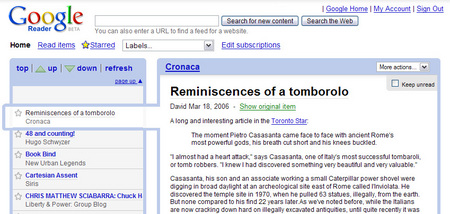
Specifically, I use Google Reader to view my feeds because it displays posts in one continuous queue. I cannot easily skip things; I have to read posts in the order in which they come in. (If Cliopatria has a post at 11:00 a.m. and my friend Wheeler has a post at 10:58, GR displays the one entry right after the other.) Back when I used Bloglines and Thunderbird's built-in reader, by contrast, my feeds were broken up by source, so I could skip reading entire sites if I didn't have much time. That biased my reading habits; I wouldn't look at some blogs for weeks, especially as my list of feeds got longer.
Today, I monitor 194 sites with Google Reader, and I add to that list frequently. Unfortunately, I have almost stopped adding new blogs to this site's sidebar. I just add their RSS feeds to my reader instead. That means that I get swamped with information (a problem I love having) but my visitors don't get to see all of my wonderful finds. I am going to try to fix this problem over the next few weeks.
| Posted by Wilson at 18:42 Central | Link | TrackBack (0)
| Report submitted to the Communications Desk
17 March 2006 - Friday
Reading list
To celebrate an "opposite day," which involves writing non-parodic defenses of views opposite to one's own, Jason Kuznicki makes a plea for the divine right of kings. He explains himself here.
Meanwhile, in Perspectives, Jerry Z. Muller is exhorting academics to write better.
Phil Renaud, looking closely at his university grades, has turned up some evidence that the fonts he uses have affected his essay scores. I've operated on the same theory for years; it's one of the reasons I tend to use Book Antiqua or another less common serif face rather than pedestrian Times New Roman.
Michael A. G. Haykin has posted a long entry on St. Patrick.
| Posted by Wilson at 12:19 Central | Link | TrackBack (0)
| Report submitted to the Communications Desk
15 March 2006 - Wednesday
History Carnival XXVII
The twenty-seventh History Carnival has been posted at History : Other. Here are some entries that immediately caught my eye:
Natalie Bennett profiles Ranavalona, the anti-colonial and anti-missionary queen of Madagascar. >>Other recent carnivals of note: Carnivalesque XIII and the Carnival of Bad History V.For her "Sunday protest blogging," Maia describes the 1981 rugby anti-apartheid protests in New Zealand. >>
Is historicism sexy? Scott Eric Kaufman thinks so. >>
Grant Jones is telling the story of the Battle of the Bismarck Sea. >>
| Posted by Wilson at 9:55 Central | Link | TrackBack (0)
| Report submitted to the Communications Desk
12 March 2006 - Sunday
Undergraduate bloggers
One thing that bothers me about the blogosphere-as-academic-tool concept is the apparent absence of undergraduates from the scene. I can name plenty of teachers, grad students, and interested laypeople who spend a significant amount of time blogging in academic ways (I can't think of a better catchall description), but most undergraduate bloggers don't seem to participate in the same conversations, even when they have related interests. To me, this seems like a wasted opportunity.
If I am right about this problem, I can think of lots of reasons for it. We undergrads are quite a bit less knowledgeable about ... well, everything, really, so it makes sense that we would find it difficult to follow the shoptalk of our elders. We don't really have our own research to contribute; our school work isn't generally the sort of thing that leads to interesting, original writing. Also, undergraduates are more or less obligated to maintain social lives that have nothing to do with our studies, so perhaps undergraduate blogging doesn't meet the same cultural/social needs that it does for graduate students. Undergrad blogs, in my experience, usually look a lot like high school blogs; they reflect our being in school but demonstrate clearly that we do not have our own academic identities yet. It's not just that the level of the writing is lower.
Apathy is always possible, of course, but I don't think apathy by itself explains the problem. Quite a few graduate students blog; where are the blogs of the people who plan to become grad students? Or rather, why do so few of those blogs have an academic focus? Undergraduates are probably more likely than anybody else to blog, but I don't see many of them talking about their academic interests much.
Here's my theory. Blogging generally requires a writer to do much more than hold up one end of a conversation; the academic blogger must be knowledgeable enough (and have enough free time) to present self-contained discourses, whether or not readers provide any feedback. Furthermore, specialized blogging tends to discourage comment from uninitiate readers like undergraduates. So on both ends of the discussion, most undergraduates have no way to get involved in the academic blogosphere, even if they would like to.
I wonder whether an old-fashioned Web forum approach could help. Bulletin boards might be able to nurture an academically-oriented community among undergrads without requiring the same kind of specialized knowledge from them. Such bulletin boards, though, ought to be publicly viewable and integrated as much as possible with the resources available at the academic blogs; they should involve input from professors and grad students.
The trick would be getting undergrads involved in these online communities -- which, I admit with some chagrin, takes me almost back to where I started. How can we coax undergraduates into discussing their academic interests in public?
| Posted by Wilson at 23:59 Central | Link | TrackBack (0)
| Report submitted to the Communications Desk
22 February 2006 - Wednesday
Reading list
Francis Fukuyama presents an intellectual history of neoconservatism, explaining where he thinks the movement went wrong.
For the sake of the new arrivals in academia, Michael Drout provides some fun guidelines for academic reading and writing.
Richard Nokes thinks he's found the reason medievalists are such avid bloggers. They're lonely.
Hugo Holbling describes the philosophy of Dutch soccer, "the most beautiful football in the world."
At The New Pantagruel, Dan Knauss discusses "Christian Humanism, Past and Present," arguing that humanism and modernism are not such close kinsfolk as often believed. Naturally, Erasmus gets a lot of play.
| Posted by Wilson at 22:51 Central | Link | TrackBack (0)
| Report submitted to the Communications Desk
18 February 2006 - Saturday
Reading list
Ken Ristau and Tyler F. Williams present their lists of movies essential for theologians.
I'm not sure, but Callimachus may be trying to offend everyone on earth with this list of racial insult etymologies.
Inside Higher Ed's Scott Jaschik mentions a study detailing the angst and disenfranchisement of 9,000 graduate students. Who would have thought?
Jonathan Rowe challenges Claremont and David Barton on the significance of the Christian foundations of Western law.
| Posted by Wilson at 13:06 Central | Link | TrackBack (0)
| Report submitted to the Communications Desk
15 February 2006 - Wednesday
History Carnival XXIVa
The latest History Carnival is up at Philobiblon.
Alun ponders the meaning and future of gender archaeology. >>Lots more where those came from!Tony presents two recipes from 1923's The Stage Favourites’ Cook Book. >>
Misteraitch provides some scanned illustrations from the early days of natural history. >>
Nouri Lumendifi elaborates a theory of nationalism that contrasts Western and Eastern forms. >>
| Posted by Wilson at 10:12 Central | Link | TrackBack (0)
| Report submitted to the Communications Desk
12 February 2006 - Sunday
Reading list
In the March/April issue of Foreign Affairs, Michael Herzog (brigadier general in the Israeli Defense Forces) says the chances that democracy will moderate Hamas are slim.
In the same issue, Paul R. Pillar (former CIA official) claims the Bush administration used intelligence "not to inform decision-making, but to justify a decision already made" in the days before the Iraq invasion.
Jonathan Edelstein is hosting an Old Bailey proceedings blog symposium. Sharon Howard's contribution is a two-part entry on arson in 18th-century London.
Thanks to this, I think this should be my new search engine.
| Posted by Wilson at 20:36 Central | Link | TrackBack (0)
| Report submitted to the Communications Desk
1 February 2006 - Wednesday
History Carnival XXIV
He found matter of study to fill a hundred years, and his education spread over chaos. Indeed, it seemed to him as though, this year, education went mad. -- The Education of Henry Adams
World's Cliovian Exposition of 2006
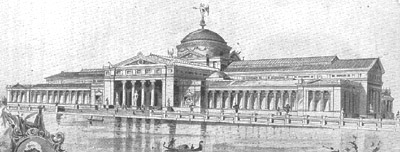
Welcome, ladies and gentlemen, to the Twenty-Fourth History Carnival! History bloggers (historians, students, and amateurs) have come here from all corners of the world to display their work. This self-guided tour will help you find the best our exposition has to offer.
To enter the exposition complex, please head toward the statue of Clio Trampling the Masses, which rises triumphalistically above the main gates. This intriguing sculpture sets the perfect mood for the many exhibits to follow. Once you pass through the gates, please keep to the right of the Reflecting Pool in order to enter the Narrative and Historiography Building.
Continue reading "History Carnival XXIV" below the fold . . .
| Posted by Wilson at 0:00 Central | Link | TrackBack (0)
| Report submitted to the Communications Desk , Humanities Desk
30 January 2006 - Monday
Last call for History Carnival
The next History Carnival goes up right here on Wednesday. Many people have submitted nominations, but there's still time to direct me to great posts!
I still particularly need entries in modern non-Western; modern Western (non-American); political/military/diplomatic; and religious history. I'd also like to see a few more entries from non-professionals.
Send them to JonathanWilson (at symbol) letu.edu.
| Posted by Wilson at 18:54 Central | Link | TrackBack (0)
| Report submitted to the Communications Desk
22 January 2006 - Sunday
Call for posts: History Carnival
The next edition of the History Carnival will be hosted right here! I am asking everyone for nominations.
The purpose of the History Carnival is to highlight the best and most interesting history-related posts of bloggers everywhere. Contributors do not have to be professional historians. In fact:
History is an enormous subject, and we hope a wide range of blogs and topics can be represented so that there will always be something familiar and something unexpected for everyone. It must be stressed that it's not just for academics and specialists, that entries certainly don't have to be heavyweight scholarship. But they do have to uphold certain standards of factual accuracy and integrity in the use of sources. All submissions will be vetted by the host, whose decision is final.I appreciate any nominations you can provide (a fuller list of rules governing inclusion is located at the site linked above). Please email me the URLs of your favorite recent history-related posts, preferably published since 15 January, by the end of this month. (You can also use this online form.) My address is JonathanWilson at symbol letu period edu.
By the way, a great place to look for history blogs is the list maintained by the group blog Cliopatria.
| Posted by Wilson at 11:56 Central | Link | TrackBack (0)
| Report submitted to the Communications Desk
16 January 2006 - Monday
Reading list
Blogging from Kuwait, Sgt. Chris Bray (US Army; UCLA history) has begun a series of posts to explain why he thinks the war is "probably unwinnable" and why our soldiers' position on the ground is "painfully untenable." Bray, incidentally, is arguing as a conservative. The introduction is here. In part 1, Bray explains why our soldiers and our journalists interpret the situation in Iraq differently (hint: the journalists know Arabic). In part 2, he questions the actual value of America's superior firepower.
Popular Mechanics is giving away a small earthmover. That's so cool. (Via Dave Barry)
Dahlia Lithwick provides Senate Democrats with a helpful, stereotype-free guide to the American federalist: "Once you acquaint yourself better with the federalist, it is our belief that you will come to love him as we do. You are free to pet the soft, luxuriant hair of any federalist you see here today. But Sen. Kennedy, please stop poking him with a pointy stick." (Via Volokh)
Translate a letter for a lawyer, spend 20 years in prison? (Via MeFi)
| Posted by Wilson at 17:05 Central | Link | TrackBack (0)
| Report submitted to the Communications Desk
15 January 2006 - Sunday
History Carnival XXIII
The twenty-third History Carnival is up at Old is the New New. Rob MacDougall has cataloged a full month of posts in a very stylish format. Here are a few of the entries:
Ed Podesta describes the philosophy behind the "grand" tradition of British school history, which emphasizes the transmission of a particular culture. >>The next History Carnival will be hosted right here on 1 February. Please send nominations for entries (preferably posted between today and then) to JonathanWilson at letu.edu -- or simply use the submission form here.K. M. Lawson comments on an unusual history lesson at a Japanese high school. >>
James R. Rummel has discovered that the US government turned to the American Historical Association during World War II to help answer questions like "Can War Marriages be Made to Work?," "Do You Want Your Wife to Work After the War?," and "Will There be a Plane in Every Garage?" The AHA's Web site reproduces 43 of these pamphlets. >>
Nathanael D. Robinson proposes a list of ten events that students need to know in order to understand contemporary France. >>
Tim Burke describes the melancholy induced by tight security around historical landmarks in Philadelphia. >>
Mortimer Randolph is interested in Scotland's experience with bison. >>
| Posted by Wilson at 12:52 Central | Link | TrackBack (0)
| Report submitted to the Communications Desk
11 January 2006 - Wednesday
Anonymous bloggers, beware
Law prof Eugene Volokh says yes, a new law's obvious problem is indeed an obvious problem.
According to Volokh:
This potentially criminalizes any anonymous speech on a Web site that's intended to annoy at least some readers, even if it's also intended to inform other readers. This is true whether the poster is berating a government official, a religious figure, a company that he thinks provides bad service, an academic who he thinks is doing or saying something misguided, a sports figure who he thinks is misbehaving, or what have you; so long as he's trying to annoy any recipient (whether the target, if the poster thinks the target is reading the blog, or the target's partisans or fans).It's already been signed, folks. Federal law now seems to make it illegal to annoy people anonymously on the Internet -- an offense punishable by fines and two years in prison.
Apparently, this was an unintended effect of overly broad language in the bill, which was supposed to cover VOIP telephones.
| Posted by Wilson at 15:59 Central | Link | TrackBack (0)
| Report submitted to the Communications Desk
8 January 2006 - Sunday
Cliopatria Awards
The Cliopatria Awards were announced yesterday at a session of the AHA's annual meeting. The awards recognize excellence in history blogging. Here are the judges' choices:
Best Individual Blog: Mark Grimsley's Blog Them Out of the Stone AgeBest Group Blog: K. M. Lawson, Jonathan Dresner, and others, at Frog in a Well
Best New Blog: "PK"'s BibliOdyssey
Best Post: Rob MacDougall's "Turk 182" at Old is the New New (9 January 2005)
Best Series of Posts: Nathanael Robinson's "The Geographical Turn," Parts One, Three, at Rhine River.
Best Writer: Timothy Burke at Easily Distracted
| Posted by Wilson at 20:01 Central | Link | TrackBack (0)
| Report submitted to the Communications Desk
6 January 2006 - Friday
Reading list
You're a Surrealist. You have a Mexican jumping bean. What do you do with it? (Via The Valve)
Miriam Burstein examines the nature of truth-telling in historical fiction.
OCLC staff member George Needham thinks library fines should be eliminated.
The Economist is talking about the world's greatest pranks -- and asking for nominations for the best. (Via A&LD)
Rick Shenkman of HNN is bringing us highlights from the American Historical Association's annual meeting in Philadelphia. You can hear HNN's podcast interviews with leading historians.
The history bloggers at the convention, by the way, have a roundtable session all their own on Saturday morning.
| Posted by Wilson at 15:48 Central | Link | TrackBack (0)
| Report submitted to the Communications Desk
28 December 2005 - Wednesday
Reading list
Matt Zoller Seitz argues that Hollywood has made the American public willing to condone torture when it's done by the good guys. (Via AJ)
Brendan O'Neill says that in its reactions to the trials of Orhan Pamuk and David Irving, Europe is promulgating a double standard on free speech. (Via A&LD)
Not only is the United States an empire, argues Chris Bertram, it is an empire in more than one traditional sense.
Meanwhile, John Gray critiques Robert Kaplan's imperial vision, suggesting instead that we are returning to an era of great powers. (Via 3QD)
Die Welt's Paul Badde interviews Pedro Barrajon, a Roman Catholic exorcist.
| Posted by Wilson at 10:49 Central | Link | TrackBack (0)
| Report submitted to the Communications Desk
22 December 2005 - Thursday
Reading more list
Doug Johnson predicts that the courts eventually will promulgate a test to enforce religious neutrality, not secularism, in the public schools: "where IDers have been put in the dubious position of having to argue that ID serves a secular purpose, those opposed to ID will soon be in the awkward position of having to argue that evolution is in no way hostile to religion."
The teaser trailer is out for Apocalypto. (Via FilmChat)
Jared Wheeler is posting his senior undergraduate research project, "Exorcising the Demons of Myth and Myopia: The Southern Literary Renaissance, 1929-1965" in segments -- minus the gallons and gallons of footnotes, sadly. Parts I, II, III, and IV are up so far.
| Posted by Wilson at 20:47 Central | Link | TrackBack (0)
| Report submitted to the Communications Desk
16 December 2005 - Friday
History Carnival XXII
The twenty-second History Carnival is up at Frog in a Well - Korea, with Jonathan Dresner serving as host. As usual, I present a sample:
Mark A. Rayner has unearthed the lost PowerPoint slides of the reign of Elizabeth I. >>Natalie Bennett is recommending the work of a Victorian novelist who had some feminist leanings. >>
Eric Muller has found a memo explaining why the US refused to bomb railroad tracks leading to Nazi death camps during World War II. >>
Kristine Steenbergh has been researching British early modern swimming. >>
| Posted by Wilson at 21:06 Central | Link | TrackBack (0)
| Report submitted to the Communications Desk
1 December 2005 - Thursday
History Carnival XXI
The twenty-first History Carnival is up at CLEWS: The Historic True Crime Blog. This edition features several bloggers I haven't seen before, including the following:
Greg tells us about two saints named Gregory. >>Brett Holman notes an interesting perspective on air power at the beginning of World War II. >>
Evan Roberts identifies today's suspicions of Wal-Mart as part of a long tradition of concerns about mass retailing -- and suggests that an opposing utopian view exists as well. >>
Jonathan Edelstein recounts the unexpected downfall of a successful thief in 18th-century London. >>
Kerim Friedman attacks the cliché of the "ancient peoples." >>
| Posted by Wilson at 16:07 Central | Link | TrackBack (0)
| Report submitted to the Communications Desk
14 November 2005 - Monday
Reading list
I ran across a link to The Virtual Typewriter Museum yesterday. (MeFi)
Crooked Timber's John Quiggin has been using Google to track different versions of a quotation used frequently in the global warming debate.
Peter Schilling is contemplating "Technology as Epistemology" at Academic Commons.
At Presentation Zen, Garr Reynolds reminds us that PowerPoint slides and handouts are not (supposed to be) the same thing.
Saturday, I passed the campus post office after it had already closed. I discovered in my box the latest issues of American Historical Review and Perspectives, as well as a package notice for a "manila envelope." I waited patiently for the post office to open this morning so that I could see whether the envelope contained my GRE scores or my Oxford UP order. It contained the latter -- Isaiah Berlin's Four Essays on Liberty, expanded significantly. I've been reading it in bits and pieces between classes.
| Posted by Wilson at 12:39 Central | Link | TrackBack (0)
| Report submitted to the Communications Desk
7 November 2005 - Monday
Reading list
Sharon Howard hosts Carnivalesque #10 at Early Modern Notes.
Writing for Foreign Affairs, Kenneth Neil Cukier describes the current international struggle over Internet governance. (XIL)
At The New Pantagruel, D. G. Hart (musing on the career and ecumenism of Mark Noll) wonders whether "flirting with Roman Catholicism will lure away young talent from evangelical circles ... which will erode further the prospects for an evangelical mind."
In the Boston Globe, Andrew J. Bacevich argues that the United States should revisit realism as a foreign policy -- but the realism of Niebuhr and Kennan, not Kissinger. Original sin makes an appearance in the article. (ALD)
If those fail to stimulate thought, please see "Things to do when you're bored." (MeFi)
| Posted by Wilson at 2:05 Central | Link | TrackBack (0)
| Report submitted to the Communications Desk
31 October 2005 - Monday
The Cliopatria Awards
The blogosphere's flagship history site, Cliopatria, has unveiled an award for excellence in historical blogging. The award has six categories: best group blog, best individual blog, best new blog, best post, best series of posts, and best writing.
Judging will be handled by three distinguished committees of history bloggers. They will make their decisions in December, with the winners to be announced at the American Historical Association convention in Philadelphia. During November, we are asked to make nominations for the various categories. It sounds like a great deal of fun.
| Posted by Wilson at 9:25 Central | Link | TrackBack (0)
| Report submitted to the Communications Desk
15 October 2005 - Saturday
History Carnival XVIII
The eighteenth History Carnival is up at Acephalous. Entries I have checked so far include:
John McKay examines T. E. Lawrence's rediscovered plan for national borders in the Middle East. >>K. M. Lawson compares different accounts of Japanese annexation of Korea. >>
Kristine Steenbergh reflects on a reference to "mourning in steel" in Shakespeare's Henry VI, making inferences about post-Reformation culture. >>
Phil Harland provides links for those interested in the Roman empire's cult of the emperors. >>
PK provides some woodcuts from a classic medieval volume on metallurgy. >>
| Posted by Wilson at 23:10 Central | Link | TrackBack (0)
| Report submitted to the Communications Desk
13 October 2005 - Thursday
A plea for growing up
This is sad. I spent half an hour of my time yesterday trying to keep the expression "seeing-eye bitch" from being censored by our student newspaper.
The expression was used in a book review that I copy-edited. It is a direct quotation from the book under discussion. After listening to the reviewers, I am convinced that this expression is useful in the review as a way to capture an important aspect of the book. It seems, however, that some other people are nervous.
Now, this controversy is not that important by itself. Removing the expression will weaken the review -- if only by making it less interesting -- but the review is still excellent. However, I object as strongly as the reviewers to the excision of the phrase.
Who do we think will take offense at the inclusion? Seeing-eye dogs? Small children -- because so many of them read our book reviews? People with no vocabulary or sense of context whatsoever?
Or is this just a reflex? At a conservative Christian school, when we see a word like "bitch" in any context, we're supposed to drown it quietly to avoid contamination.
It is degrading. It is degrading because it implies an incredible ignorance and weakness of mind on the part of our readership. It is degrading because we are subjecting excellent staff writers to the sensitivities of an imaginary sanctimonious crank -- one highly unlikely, actually, to care about this novel. In a larger sense, it is degrading because it keeps us from interacting with our culture respectfully. We evangelicals love to make a show of putting conversational perfumed handkerchiefs to our noses, avoiding the odors of our neighbors.
| Posted by Wilson at 10:20 Central | Link | TrackBack (0)
| Report submitted to the Communications Desk
2 October 2005 - Sunday
Troll disposal
Afflicted by a commenter best known to them as the Troll of Sorrow, the authors at The Valve have developed an array of techniques for dealing with unmannerly Internet guests. Hilarity has ensued, and I am taking notes.
| Posted by Wilson at 20:14 Central | Link | TrackBack (0)
| Report submitted to the Communications Desk
History Carnival XVII
The seventeenth History Carnival is up at The Apocalyptic Historian. Here are a few of the likely-looking entries:
Misteraitch posts some images related to Jesuit scholar Athanasius Kircher's fascination with Egyptian obelisks. >>Greg James Robinson and Eric Muller argue that a recently published World War II memorandum undercuts Michelle Malkin's defense of Japanese internment. >> | >>
Maharajadhiraj contemplates the esoteric meaning of a building called Lion's Orbit. >>
PK provides some scans of emblem books -- early modern ethical tracts relying on allegorical illustrations. >>
Hugo Holbing examines evolving views of mental illness and proper behavior. >>
| Posted by Wilson at 14:56 Central | Link | TrackBack (0)
| Report submitted to the Communications Desk
27 September 2005 - Tuesday
Reasons to read blogs
Many people are noticing BibliOdyssey, a history blog specializing in graphics.
Robert Farley makes a case for calling a French officer in The Battle of Algiers one of the most evil characters ever put to film. In fact, he says, "this is the core of twentieth century evil." Via Mark Grimsley.
In three posts, Nathanael Robinson maps out the Annalistes' relationship with geography.
Michael Drout gives the president of the MLA a drubbing for an obfuscatory article about academic freedom: "Prof. Stanton, you write like a committee." Having a copy of PMLA in my book bag right now, I ask whether this can be surprising.
For those looking for alternative scientific theories, Sylwester Ratowt reports on the hollow earth.
| Posted by Wilson at 14:03 Central | Link | TrackBack (0)
| Report submitted to the Communications Desk
15 September 2005 - Thursday
History Carnival XVI
The sixteenth History Carnival is up at Respectful Insolence. The collection follows a History Channel theme.
A few selections:
Peter Kirby delivers an introduction to historical method. >>Brooks D. Simpson discusses what he learned from participating in a television documentary. >>
Mark A. Rayner has found the lost PowerPoint slides of William Wallace. >>
David Noon describes the largest slave revolt in the history of colonial North America. >>
Rob MacDougall examines (and questions) the "Good Flood" of 1927. >>
| Posted by Wilson at 10:33 Central | Link | TrackBack (0)
| Report submitted to the Communications Desk
2 September 2005 - Friday
History Carnival XV
The fifteenth History Carnival was posted at ClioWeb ... yesterday.
Jim Davila marks the anniversary of the eruption of Vesuvius. >>Et cetera.Misteraitch covers a Swedish witchcraft account from the seventeenth century. >>
Michael McNeil contradicts conventional wisdom regarding the origin of zero. >>
Barista provides takes a look at oddities of burial custom, especially in Britain. >>
Meanwhile, I'm still here, and I hope to resume regular blogging soon.
| Posted by Wilson at 14:47 Central | Link | TrackBack (0)
| Report submitted to the Communications Desk
14 August 2005 - Sunday
History Carnival XIV
The fourteenth History Carnival is up at Philobiblon. Among the delicacies:
Nosemonkey takes a look at treason statutes in Britain. Let's just say that fixing your pets could be a matter of life and death, and it is inadvisable to kill any swans in the UK. >>As always, you can find more where these came from. If you look carefully, you may see something about hobbits.Sudha Shenoy notes the origin of the term jingoism. >>
Alun examines the possibility that Zoroaster’s Kaba is a calendrical and astronomical building. >>
Troels looks at archaeological evidence suggesting "fluid borders" between Christian and pagan observance in Corinth between the fourth and sixth centuries. >>
According to Mohraz, Cyrus' conquest of Babylon resulted in the first declaration of human rights. >>
| Posted by Wilson at 21:18 Central | Link | TrackBack (0)
| Report submitted to the Communications Desk
13 August 2005 - Saturday
And in that other reality
The newspaper Shargh (recently profiled in a story about Iranian press freedom on PBS' Wide Angle) reports that Iran Telecom has ordered that Blogrolling be blocked.
| Posted by Wilson at 16:43 Central | Link | TrackBack (0)
| Report submitted to the Communications Desk , Power Desk
12 August 2005 - Friday
Memory and mourning
There's something interesting afoot at Kesher Talk. Judith Weiss has organized a "blogburst" focusing to the Temple Mount in Jewish history and contemporary politics. It has been released to coincide with Tisha B'Av, the day of mourning for the destructions of the temple in Jerusalem and for other tribulations endured by the Jewish people.
The entries in this collection have a political as well as an historical purpose. They protest the destruction of archeological artifacts at the Temple Mount and document the Hebrew presence in ancient Israel. (There are entries from Ralph the Sacred River and Paleojudaica, which first alerted me to the collection.) The blogburst also includes contributions related to contemporary culture.
The main page of the collection is here.
| Posted by Wilson at 16:05 Central | Link | TrackBack (0)
| Report submitted to the Communications Desk
11 August 2005 - Thursday
A pleasant discovery
After a year of silence, The Religious Policeman is back.
He's now blogging from the United Kingdom, which obviously allows a little more freedom for that sort of thing than Saudi Arabia does.
| Posted by Wilson at 22:33 Central | Link | TrackBack (0)
| Report submitted to the Communications Desk
Hear me roar
Thanks to a recent surge in linkage, I'm now a large mammal in the TTLB ecosystem.
| Posted by Wilson at 21:31 Central | Link | TrackBack (0)
| Report submitted to the Communications Desk
9 August 2005 - Tuesday
HNN: Now with slightly less ugly
Finally, HNN has a new look! I still think the commenting system needs a fundamental reworking, though.
The remodeling comes just in time for Cliopatria's symposium on Akira Iriye's "Beyond Imperialism: The New Internationalism." So far, Greg Robinson, Jonathan Dresner, and Manan Ahmed have posted their comments on Iriye's article. Brandon Watson has also posted some thoughts on empire at Siris.
Update: Aha! I've learned that HNN's makeover comes courtesy of ClioWeb's Jeremy Boggs. I am grateful for his work. Three cheers!
| Posted by Wilson at 0:05 Central | Link | TrackBack (0)
| Report submitted to the Communications Desk
5 August 2005 - Friday
Carnivalesque : ancient and medieval
Carnivalesque, the History Carnival's older and more specialized brother festival, is up in its first ancient/medieval edition at The Cranky Professor.
Interested in the ancient origins of mathematics? Alun looks at whether addition or multiplication came first. Want to know what the Jebusites, Amorites, Moabites, and Phoenicians have to do with modern Palestinian nationalism? A lot, apparently. Think the young people are getting awfully licentious these days? So did Bishop Cox in 1579. Happy surfing.
| Posted by Wilson at 8:42 Central | Link | TrackBack (0)
| Report submitted to the Communications Desk
1 August 2005 - Monday
History Carnival XIII
The thirteenth History Carnival is up at WILLisms.
A sample of the entries, starting from the bottom of the list this time:
Alterior examines the life of that venerable ailment, tuberculosis >>Lewis Hyde looks at early modern ideas about individual talent and intellectual property >>
Sharon Howard shares a collection of Stuart-era political poetry >>
Antti Leppänen questions some inflated accounts of the Japanese occupation of Korea >>
Dan Melson tries to compare the origins of Christianity and Islam >>
Nathanael Robinson contextualizes Gottfried von Strassburg's Tristan >>
| Posted by Wilson at 12:33 Central | Link | TrackBack (0)
| Report submitted to the Communications Desk
18 July 2005 - Monday
In others' words: book edition
Thanks to a basic knowledge of this interweb thingy, Tim Lambert has collected some pretty good evidence that John Lott (the "more guns, less crime" guy) has been defending his own work under different screen names. This is not a new allegation, but Lambert's work is particularly thorough. >>
Speaking of the communications age, Sharon Howard offers some ideas about why Harry Potter and similar book phenomena get fans so excited. >>
The New Yorker ventures into Roald Dahl's lair. >>
Tyler Williams covers the discovery of possible new Dead Sea scrolls. There are two fragments, apparently from Leviticus 23 and 24. They look genuine to Williams. >> Jim Davila still recommends caution. >>
Update: Regarding Harry Potter again, Jonathan Dresner explains why the books bother him a little:
I'm an historian, and a social historian at that, and I can't fathom how Rowling's world came to be, or how it functions. That drives me nuts. The students are always doing history papers, most of which are amusingly dreadful antiquarianism, but there's no discussion to speak of of anything that happened more than two generations ago. Worse, there's no sense of evolution, no sense of change. And that is wrong. >>
| Posted by Wilson at 9:06 Central | Link | TrackBack (0)
| Report submitted to the Communications Desk
16 July 2005 - Saturday
In others' words: jihad edition
In "My Enemy’s Friend Is My Enemy" at Liberty & Power, Sudha Shenoy insists that jihadism must be recgonized as a political struggle within Islam.
At Chapati Mystery, Sepoy argues that school shootings and The Matrix can tell us something about the mentality that fosters terrorism.
William F. Buckley says that world war is easy. Changing minds is hard.
The Pew Global Attitudes Project finds that in Muslim countries, support for terrorism and confidence in bin Laden have generally been falling (especially since 2004, where the data are that specific).
"I Am the Very Model of a Modern Labour Minister" is a Flash lampoon of Britain's national ID cards.
| Posted by Wilson at 15:07 Central | Link | TrackBack (0)
| Report submitted to the Communications Desk
15 July 2005 - Friday
History Carnival XII
The twelfth History Carnival is up at Mode for Caleb! There's lots of historical and historiological goodness to be had.
A sample of the entries:
Nathanael Robinson writes that the bourgeoisie in nineteenth-century Europe was more radical than we often assume. >>Susan Kitchens liveblogs the Trinity atomic bomb test. >>
In a trademark multi-part post, Mark Grimsley examines the American Civil War as "a people's war." >>
Brandon Watson looks at Alexander Hamilton's religious beliefs and tragic demise. >>
Alun illustrates the usefulness of RSS to historians. >>
Barista investigates a mysterious prank aboard the ship of James Cook. >>
| Posted by Wilson at 8:09 Central | Link | TrackBack (0)
| Report submitted to the Communications Desk
14 July 2005 - Thursday
Ahem
It's, uh ... it's Bastille Day again. As some of you may know, this is the anniversary of --
*Flees*
| Posted by Wilson at 20:08 Central | Link | TrackBack (0)
| Report submitted to the Communications Desk
9 July 2005 - Saturday
Fox host speaks indelicately
Nation shocked.
From the July 6 broadcast of Westwood One's The Radio Factor with Bill O'Reilly, guest-hosted by [Fox News host John] Gibson:GIBSON: By the way, just wanted to tell you people, we missed -- the International Olympic Committee missed a golden opportunity today. If they had picked France, if they had picked France instead of London to hold the Olympics, it would have been the one time we could look forward to where we didn't worry about terrorism. They'd blow up Paris, and who cares?
| Posted by Wilson at 23:36 Central | Link | TrackBack (0)
| Report submitted to the Communications Desk
8 July 2005 - Friday
Weighing the risks
Everybody seems to be talking about an article by "Ivan Tribble" in the Chronicle of Higher Education: "Bloggers Need Not Apply." It warns academics away from blogging:
Our blogger applicants came off reasonably well at the initial interview, but once we hung up the phone and called up their blogs, we got to know "the real them" -- better than we wanted, enough to conclude we didn't want to know more.Naturally, this is of some concern to me. I started blogging early in my undergraduate career, and my identity has never been hard to figure out. Forget tenured v. untenured blogging; I haven't had my undergraduate research seminar yet.
On the other hand, I've always been miserable in interviews anyway. The context-free sales pitch described (recommended) in this article has never treated me kindly. I really don't think I have much to lose.
Furthermore, I think other LETU students may agree with me that any publicity for students in humanities programs as minimalistic as ours is good publicity. If we can demonstrate some degree of competence and familiarity with our fields, even tangentially, we will be doing ourselves a favor. That is why I haven't tried to bury this blog and start over anonymously. I actually want my name attached to something.
One other thing. I agree with Brandon entirely: "I'm not sure I'd want colleagues who are so far behind the times that they'd make such odd inferences. ... What sort of crazy, sour-faced, self-righteous department would that be?"
| Posted by Wilson at 21:59 Central | Link | TrackBack (0)
| Report submitted to the Communications Desk
1 July 2005 - Friday
History Carnival XI
I am heading up to East Texas for the weekend. I want to take in the Texas Shakespeare Festival, which I had to miss last year, in the company of friends who are still in the area. Rumor has it that the performances are very good. I'm forced into an unfortunate trade, though: I have to miss The Philadelphia Story and Woman of the Year at the Paramount. Hepburn, Shakespeare ... Shakespeare, Hepburn ....
Right. While I am on the road, please visit the eleventh History Carnival, tenderly woven together by the redoubtable Brandon Watson. This edition is particularly colorful and carnival-like. Among the posts included:
Eric Muller looks at a Boy Scout Jamboree that took place in a Japanese-American internment camp during World War II >>It's just possible that the carnival includes an entry from your humble servant.Manan Ahmed describes a Pakistani woman's fight for justice, which could be the start of something far greater. >>
Lauren looks at the iconography of St. Peter Martyr. >>
Orac reflects on the pitfalls of the argumentum ad Nazium. >>
| Posted by Wilson at 9:00 Central | Link | TrackBack (0)
| Report submitted to the Communications Desk
21 June 2005 - Tuesday
Yellow Project gets shinier
Eliot has announced the revamping of the main page of the Yellow Project. It now aggregates member posts so we can see what everybody's saying. Nifty!
This is another reason for all LETU people with blogs to list themselves at the Yellow Project, make sure their RSS feeds work, and perhaps get Gravatars while they're at it (I uploaded mine over the weekend).
| Posted by Wilson at 21:30 Central | Link | TrackBack (0)
| Report submitted to the Communications Desk
15 June 2005 - Wednesday
History Carnival X
The tenth History Carnival is up at Spinning Clio. Here are a few of the entries worth reading:
Alterior discusses the role the Black Death played in allowing some medieval women to enter the business world (with nifty graphics). >>Lots more where those came from.Melinama looks at the questionable validity of the memoir of Jean Lafitte, whose name I knew dimly as that of our local pirate when I was growing up near the Gulf Coast. >>
Tom Corrente, after grading AP exams in US history, objects to the saccharine version of early America reflected in student essays; he also thinks that the revolutionary generation was more willing to question its government than ours is. >>
Mark Grimsley connects Emmett Till, military history, and bullying ... and says they need to be connected. >>
Derek Charles Catsam reviews Cinderella Man. >>
The Cranky Professor has discovered why people use bad historical analogies, at least in the information age. >>
| Posted by Wilson at 9:06 Central | Link | TrackBack (0)
| Report submitted to the Communications Desk
1 June 2005 - Wednesday
History Carnival IX
The ninth History Carnival is up at Cliopatria under the auspices of Sharon Howard. I hesitate to link to any particular entries this time; every post looks superb. Just find a link and click on it. (I am also, in theory, studying for a French exam that is scheduled to begin in an hour, so I probably shouldn't invest much time in this notice.)
| Posted by Wilson at 10:47 Central | Link | TrackBack (0)
| Report submitted to the Communications Desk
20 May 2005 - Friday
Dr. K has a blog!
Chairman Ku's Little Blue Book. Maybe we can convince Dr. J to start next.
| Posted by Wilson at 17:12 Central | Link | TrackBack (0)
| Report submitted to the Communications Desk
18 May 2005 - Wednesday
Beyond the comment form
I've already linked to Blog Them Out of the Stone Age once ... and kicked myself for failing to alert friend Barbour to its existence earlier.
Right now, Mark Grimsley (a professor at Ohio State) is on the third part of a series called "Too Monstrous for Remorse," covering the Mexican War. This particular post is an excerpt from an entry the author wrote for the Encyclopedia of War and American Society.
On the one hand, Whigs extolled the achievements of the American armies, particularly since the two principal field commanders, Taylor and Scott, were members of their party. On the other, they savaged the Polk administration for causing the war, for misrepresenting the truth in its request for a declaration of war, for mismanaging the war, and for pursuing a war aim—territorial expansion—that was at odds with American values. Republican institutions should expand by example, not coercion, some argued. Others, playing the race card, pointed out that expansion would entail the annexation of a morally degraded people who were “unfit . . . to sustain a free government.”I like this article. Beyond that, however, if you read the rest of the series and other parts of the blog, you will see why I love Grimsley's approach to academic blogging.
| Posted by Wilson at 18:57 Central | Link | TrackBack (0)
| Report submitted to the Communications Desk
15 May 2005 - Sunday
History Carnival VIII
The eighth History Carnival is up at Saint Nate's Blog. Its collection includes a few entries I recommended:
Caleb McDaniel's "John Brown and Nonviolence," which takes some book reviewers to task for implying that nonviolent action is inherently less courageous than violent action.There are many other excellent entries in this lot.Robert "KC" Johnson's "Iraq and Vietnam," which points out several flaws in analogies between the two.
Stephen Bainbridge's "Prize Money and Agency Costs" and Henry Farrell's "Rum, Sodomy and the Nash," which debate the functions served by the British Navy's institutions in the Napoleonic wars (this discussion was brought on by O'Brian's Aubrey-Maturin novels).
Bulleyah's "The Epic Story of Dastans," which describes a form of literature that seems to have disappeared yet also lingers in the literature we have today.
| Posted by Wilson at 23:59 Central | Link | TrackBack (0)
| Report submitted to the Communications Desk
10 May 2005 - Tuesday
History in blogs
Cliopatria's Manan Ahmed and Ralph Luker have teamed up in the new issue of Perspectives (newsletter of the American Historical Association) to introduce historians to the blogosphere.
In "Blogging: It's Easier Than You Think!" Ahmed defines terms like "CMS" and "RSS" and steers readers toward Blogger, TypePad, and even Technorati. Meanwhile, Luker uses "Were There Blog Enough and Time" to provide a brief history of weblogs and a description of several prominent history bloggers.
Paging Dr. K ... and all the LeTourneau history students who need to put their work online ....
| Posted by Wilson at 20:52 Central | Link | TrackBack (0)
| Report submitted to the Communications Desk
2 May 2005 - Monday
Viral literacy
Brandon was considerate enough to send this my way.
* What book in Fahrenheit 451 would you want to be?
Hmm. Earlier versions of the question have it as "apart from" rather than "in."* Oh, well. "In" makes more sense to me. I choose the Book of Ecclesiastes; the irony of 12:12 is particularly applicable here.* Have you ever been really struck by a fictional character?
I got pretty wrapped up in the fate of the title character of Jane Eyre when I read it at age 10 or 11. She was probably the first one.* What was the last book that you bought?
Excluding accessories like textbooks, I think that would be Faulkner's As I Lay Dying.* What was the last book you read?
A whim during the papal election led me to put in an ILL request for The Jeweler's Shop: A Meditation on the Sacrament of Matrimony, Passing on Occasion into a Drama, by Karol Wojtyla. I read it on Saturday instead of studying for finals. Just before starting that, I finished off Isaiah Berlin's Crooked Timber of Humanity.* Which books are you reading?
I still claim to be reading Purgatorio in The Divine Comedy; finals week should give me a chance to get back to it and finish it off. I may start back in on the second half of The Dialogic Imagination (Bakhtin) while I'm at it.* Which five books would you take to a desert island?
Do volumes count separately? 'Cause if not, Encyclopædia Britannica would be one.* To whom are you going to send this erm... let's say confession...and why? (three people)The Bible (ESV, probably).
T. S. Eliot: Complete Poems and Plays: 1909-1950.
A Norton anthology of something or other.
US Army Survival Manual.
Let's keep this going in undergraduate circles. How about Wheeler the literature and history person, Gallagher the computer and math person, and Michaela the newspaper and* Update: I've done a little background research. This survey has been mutating quite freely during its circulation in the blogosphere. My version has been mangled by translation into and back out of Portuguese. Here's a version closer to the original:elementaryhigh school education person?
You are stuck inside Fahrenheit 451. Which book do you want to be?Have you ever had a crush on a fictional character?
What is the last book you bought?
What are you currently reading?
Five books you would take to a deserted island:
Who are you going to pass this book meme baton to and why? (only three people)
| Posted by Wilson at 19:56 Central | Link | TrackBack (0)
| Report submitted to the Communications Desk
1 May 2005 - Sunday
History Carnival VII
The seventh History Carnival is up at Studi Galileiani.
| Posted by Wilson at 20:00 Central | Link | TrackBack (0)
| Report submitted to the Communications Desk
14 April 2005 - Thursday
Yahoo! News Beta
Yahoo! News, long the Internet's (and thus the world's) most convenient source of general news, is beta-testing a new format.
So far, the new design seems barely more functional than the old one. Since I'm in the school computer labs at the moment, I haven't tried it in any browser except Internet Explorer.
Yahoo! News has been due for a visual makeover for at least three years. Its template still has that "new economy" feel to it. Somehow, though, I prefer that look. It's sensible and functional, as if Yahoo! understands the nature of news: raw, industrial, unpolished.
| Posted by Wilson at 13:10 Central | Link | TrackBack (0)
| Report submitted to the Communications Desk
7 April 2005 - Thursday
Let the carnivals bloom
Here's a great idea: the first edition of the Biblical Studies Carnival. I'll be watching this one closely; the quality of the entries is striking. (Thanks to Sharon Howard at Early Modern Notes for the link.)
| Posted by Wilson at 22:23 Central | Link | TrackBack (0)
| Report submitted to the Communications Desk
16 March 2005 - Wednesday
History Carnival IV
The fourth History Carnival is up at Blogenspiel. Here are some of the entries I found especially intriguing:
Thanks to PBS, Threading the Needle has recently been learning about the early evolution of slavery in the United States; this post argues that the course slavery followed gives the lie to the "fairy tale" of American progress.
Sharon Howard tells us far more than we ever dared hope to know about ritual transvestism in early modern Europe. She seems to have strong feelings about it.
At Philobiblon, Natalie Bennett has discovered that old postcards can be fascinating.
In the face of several recent controversies over academic standards, Cliopatria's Ralph Luker reminds us that life can be complicated.
| Posted by Wilson at 18:15 Central | Link | TrackBack (0)
| Report submitted to the Communications Desk
7 March 2005 - Monday
Clever
Hello. A blog with a command line interface. Sadly, it seems to be up only for experimental purposes.
Via Joe.
Update: Aha. Here's another.
| Posted by Wilson at 14:13 Central | Link | TrackBack (0)
| Report submitted to the Communications Desk , Frivolity Desk
26 February 2005 - Saturday
History Carnival III
The third History Carnival is up at detrimental postulation (a few additional entries are here). There are several good discussions of theory as well as of particular topics and events. Here are some of the intriguing posts:
Orac tries to debunk myths about the Dresden firebombing; some follow-up analysis is here.
At The Rhine River, Nathanael compares attitudes toward written, oral, and visual evidence in history, as suggested by a PBS documentary on the disputed Vinland Map. (Dad, you may be interested in the reference to Genesis near the end of the article.)
Tim Burke reflects on recent visits to Ethiopia by Rastafarians, in which "the imagination of some in the African diaspora has come into collision with the historical reality of African societies." Burke ties this phenomenon to other disapora experiences, orientalism, and the stereotypes in The Phantom Menace.
The Little Professor comments on the historiographical approach of Victorian didactic historical fiction.
| Posted by Wilson at 18:40 Central | Link | TrackBack (0)
| Report submitted to the Communications Desk
3 February 2005 - Thursday
Spamicide
This is a lot of fun. I just killed a wave of comment spam that hit multiple SC weblogs. With a few keystrokes, I eliminated the offending messages from the blogs before their owners even knew they'd been spammed.
I also got crafty and decided to block all URLs ending in ".biz" from our comment forms. Please bleat plaintively if you feel a pressing need to supply us with such hyperlinks.
| Posted by Wilson at 12:58 Central | Link | TrackBack (0)
| Report submitted to the Communications Desk
14 January 2005 - Friday
History Carnival
The first History Carnival is up at Early Modern Notes. The best recent work of the historybloggers is on display there for your enjoyment and enlightenment.
| Posted by Wilson at 23:59 Central | Link | TrackBack (0)
| Report submitted to the Communications Desk
7 January 2005 - Friday
Sorry
I apologize for the unavailability of this site earlier today. I believe our problems have been solved.
| Posted by Wilson at 22:06 Central | Link | TrackBack (0)
| Report submitted to the Communications Desk
29 February 2004 - Sunday
The Yiddish Project
I have added a new area to my sidebar: the Yiddish Word of the Week.
This idea came out of a conversation with Wheeler today, in which we decided that this feature would be a good way to reinvigorate the "Yiddish Project" we began last semester. Inasmuch as Yiddish is perhaps the most colorful language on earth, we decided to learn as many choice expressions as possible. The new feature seemed a helpful learning tool.
One source of information in particular has been very helpful:
Leo Rosten, The Joys of Yiddish. New York: McGraw-Hill Book Company, 1968.
Please also see the Ariga Glossary of Yiddish Expressions provided by Michael Fein.
Archive of Entries:
paskudne ("poss-KOOD-nyeh") Filthy, unkind, disgusting, contemptible (e.g., The dining hall served a paskudne meal this evening) (29 February 2004)mechaieh ("m'-KHY-eh")
Pleasure, satisfaction, bliss, joy (e.g., Ah, a good book on a rainy night is such a mechaieh!) (7 March 2004)meshugana ("meh-SHOOG-eh-nah")
A crazy person (e.g., He's a complete meshugana; He's completely meshugana) (15 March 2004)shmatte ("SHMOT-ta")
A rag, piece of junk, dishonored person, slattern, or sycophant (e.g., I wouldn't be seen wearing a shmatte like that; They treat him like a shmatte; The little shmatte stole my husband; Is there anyone he doesn't agree with, the shmatte?) (22 March 2004)shtuss ("shtuss")
Nonsense or commotion (e.g., Why do you believe that sort of shtuss?; They made such a shtuss in the street) (28 March 2004)gevalt! ("ge-VOLLT!")
An intense expression of amazement, fear, or protest -- from German, "powers" (e.g., Gevalt! I saw a ghost!; She gave out a gevalt loud enough to wake the neighbors) (5 April 2004)oysgematert ("oyss-geh-MOT-tert")
Exhausted (e.g., After working all day, he's oysgematert) (11 April 2004)L'chayim ("le-KHY-im" -- the kh being quite guttural)
To life! (used as a toast, as in "to your health") (20 April 2004)yentz (rhymes with "rents")
To copulate; to cheat, to swindle, to defraud. Very coarse, an obscenity -- think of the English "screw" (e.g., Yentz you, and your little dog too!) (2 May 2004)loch in kop ("LAWKH enn kawp," guttural sound for "kh")
Hole in the head; part of the larger phrase "Ich darf es vi a loch in kop," which means, "I need it like a hole in the head" (e.g., I need to hear more of Scholl's euphemisms like I need a loch in kop.) (9 May 2004)shlemiel ("Shluh-MEEL")
A fumbler, a clumsy person, someone who is all thumbs (e.g., That shlemiel spilled hot coffee all over me! I was nearly scalded to death!) (16 May 2004)m'shigas ("meh-SHIG-es")
Insanity, craziness, locura (e.g., No, I will not join the French Foreign Legion! That's m'shigas!) (24 May 2004)hulien ("huh-LEIN")
To revel, frolic, carouse (e.g., The happy couple huliened all through the night) (31 May 2004)bissel ("BIH-sill")
A very little bit, a smidgen (e.g., Some teachers treat their students as though they had only a bissel of knowledge and intelligence to call their own) (6 June 2004)hok a tchynik ("HAWK uh chai-NIK")
Literally translated, this means "to strike a kettle." Most commonly used to signify yammering, excessive talking, nonsense talk, etc. (e.g., Stop hokking a tchynik! I quit listening to your ignorant prattle five minutes ago!) (20 June 2004)nudnik ("NUD-nick" — rhymes with "mud slick")
A pest, a nag, a monumental bore (e.g., He never stops talking about animal husbandry, the nudnik!) (27 June 2004)tsetummelt ("tse-TU-m'lt")
Confused, bewildered, scatterbrained (e.g., He was so tsetummelt last night, it's a wonder he didn't forget his own name) (7 July 2004)kvell (Ummm . . . well . . . "KVELL")
To beam with immense pride and pleasure over an accomplishment (someone else's or your own) (e.g., His parents kvelled as he climbed the platform to receive his doctorate) (11 July 2004)pisher ("PIH-sher")
A bed-wetter. A young, inexperienced person ("young squirt") (e.g., One day of kindergarten, and suddenly he thinks he knows everything, the pisher!) (26 July 2004)halevai ("hole-iff-EYE")
I hope . . . I wish . . . If only I had . . . etc. (e.g., Let's go to a movie Sunday if, halevai, we are alive. And if not we'll go Tuesday) (1 August 2004)behayme ("b'HAY-muh")
Animal - particularly used for "cow." Used to describe a dumbbell or ignoramus, or a stolid, hardworking, uncomplaining unimaginative sort (e.g., He slaves like a behayme, and for what?! No hopes, no dreams, no lofty aspirations . . . His only mechaieh seems to involve coming home oysgematert after a long day and yentzing around, if you know what I mean!) (10 August 2004)Moishe Kapoyr ("MOY-sheh ka-POYR")
A contrary, contradictory person (e.g., He's so backward, he's a regular Moishe Kapoyr!) (14 September 2004)shlepper ("SHLEP-per")
A nincompoop, an untidy person, or a beggar (e.g., I wouldn't count on a shlepper like that to be on time) (26 September 2004)kibitz ("KIB-its")
To comment idly, tease, second-guess (e.g., Are you going to help me with this, or are you just going to stand there kibitzing?) (7 November 2004)plotz (rhymes with "watts")
To split, burst, or explode with strong negative emotion; to be aggravated beyond bearing (e.g., When my parents see my report card they're gonna plotz!) (22 November 2004)
| Posted by Wilson at 15:40 Central | Link | TrackBack (1)
| Report submitted to the Communications Desk , Humanities Desk , Reference Desk